Recall (RAG Evaluation)
In RAG, if the retriever doesn't surface a relevant chunk, the LLM can't use it — so retrieval recall often sets the ceiling on answer quality. Recall measures completeness: of all the relevant chunks that exist, how many did you actually retrieve? It's usually the first thing to check when a RAG system gives incomplete answers.
💡 In one line: Recall measures how many of the truly relevant chunks the retriever actually found.
What is Recall?
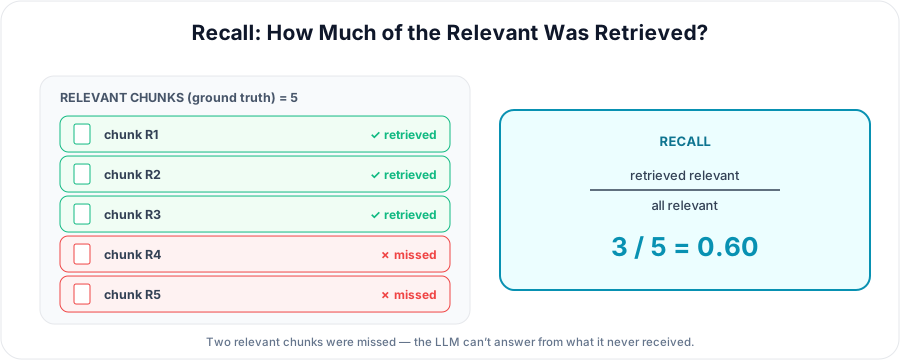
Recall is the fraction of all relevant items that were retrieved — it answers "did we find everything relevant?"
The Formula
In confusion-matrix terms:
- TP (true positives) — relevant chunks that were retrieved.
- FN (false negatives) — relevant chunks that were missed.
Recall @ k
In practice you measure recall over the top-k retrieved results — context recall @ k. A larger k generally raises recall (you cast a wider net), but there are diminishing returns and a cost.
Why It Matters in RAG
A missing relevant chunk means the LLM literally cannot answer from it — no amount of prompting fixes absent context. Recall is often the biggest lever on RAG quality, so fix retrieval before blaming the LLM.
Recall vs. Precision (Preview)
- Recall — of the relevant, how many did we retrieve? (completeness)
- Precision — of the retrieved, how many are relevant? (cleanliness)
They trade off: raising k improves recall but usually lowers precision. Precision is the next subtopic.
How to Measure
You need ground-truth relevant chunks per query (labelled), or an LLM-as-judge to decide relevance. Frameworks like RAGAS provide a context recall metric to automate this.
Improving Recall
Ways to raise recall: a better embedding model, hybrid search (catch exact terms), multi-query retrieval (more angles), better chunking, or a larger k.
Example
Suppose 5 relevant chunks exist for a query and the retriever returns 3 of them:
Trade-offs
Chasing high recall with a huge k pulls in noise, which hurts precision and can confuse the LLM. Balance it with reranking to keep the top results clean.
Summary
- Recall = relevant retrieved / all relevant — a measure of completeness.
- In RAG it often sets the ceiling on quality: missed chunks can't be used.
- Measure recall @ k against ground-truth relevant chunks (e.g. with RAGAS).
- Improve it with hybrid search, multi-query, better chunking, or a larger k.
- It trades off with precision — the next metric. EOF echo created