Retrieval-Augmented Generation (RAG): Introduction
Large language models are powerful, but they only know what they learned during training — which means they can be outdated, can't see your private data, and sometimes make things up. Retrieval-Augmented Generation (RAG) fixes this by giving the model a knowledge base: it retrieves relevant information at query time and feeds it to the LLM, so answers are grounded in real, current, and private sources. RAG ties together everything you've learned about embeddings, vector databases, and retrieval.
💡 In one line: RAG retrieves relevant documents and feeds them to an LLM, so its answers are grounded in real, up-to-date, and private data.
What is RAG?
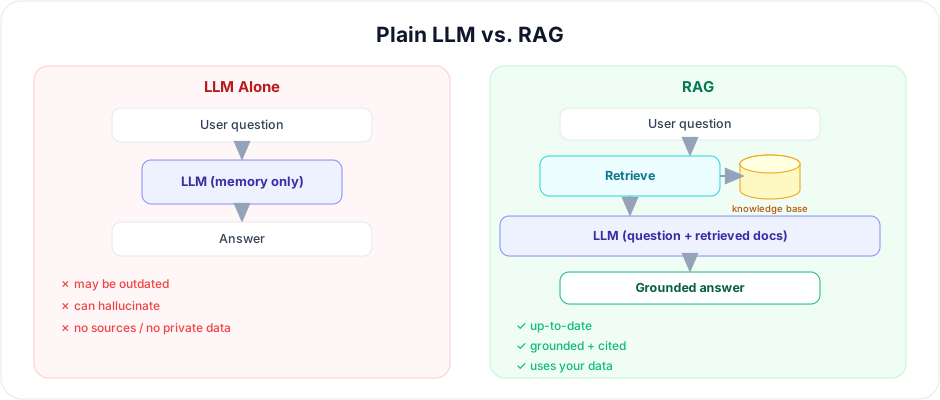
RAG combines two systems: a retriever (search over a knowledge base) and a generator (the LLM). Instead of answering from memory alone, the model answers using retrieved context — the documents most relevant to the question. It's the difference between "what the model remembers" and "what the model can look up."
Why RAG? The LLM's Limitations
A plain LLM has real gaps that RAG closes:
- Knowledge cutoff — it doesn't know anything after training.
- No private data — it can't see your company's or user's documents.
- Hallucination — it may invent plausible-but-wrong answers.
- No sources — you can't see where an answer came from.
How RAG Works
RAG runs a short pipeline at query time (after documents have been embedded and stored offline).
In short: retrieve relevant chunks, augment the prompt with them, then generate the answer.
RAG vs. Fine-Tuning
Two ways to give a model new knowledge — often used together:
| RAG | Fine-tuning | |
|---|---|---|
| Adds | Knowledge via retrieval | Knowledge/behaviour into weights |
| Updates | Easy — just change the data | Costly — retrain |
| Freshness | Current (live data) | Frozen at training time |
| Best for | Facts, documents, citations | Style, format, skills |
RAG is the go-to for up-to-date, source-backed facts; fine-tuning shapes behaviour and style.
Core Components
- Knowledge base — your documents (chunked).
- Embedding model — turns text into vectors.
- Vector database — stores and searches those vectors.
- Retriever — finds the most relevant chunks.
- LLM — generates the final answer.
- Prompt template — combines question + retrieved context.
Benefits
- Up-to-date and grounded answers.
- Uses private / domain data without retraining.
- Citations — you can show sources.
- Less hallucination, and cheaper than fine-tuning for knowledge.
Use Cases
- Q&A over documents, customer support, internal knowledge search.
- Chatbots and agents that need real, current facts.
Common Challenges (Ahead)
RAG quality depends on the details: chunking, retrieval quality, context limits, and prompt construction — the things the RAG Architecture subtopic (and the retrieval-optimization techniques) address.
Summary
- RAG pairs a retriever with an LLM so answers are grounded in real data.
- It fixes the LLM's knowledge cutoff, private-data gap, hallucination, and lack of sources.
- The pipeline: embed query → retrieve chunks → augment prompt → generate answer.
- Compared with fine-tuning, RAG is easy to update and always current.
- It builds directly on embeddings, vector databases, and retrieval optimization. EOF echo created