Graph RAG
Plain vector RAG retrieves isolated chunks by similarity — it can't connect facts across documents or reason over relationships. Graph RAG builds a knowledge graph of entities and their relationships, then retrieves by traversing it. This unlocks multi-hop reasoning and global, whole-corpus questions that vector search alone can't answer.
💡 In one line: Graph RAG retrieves over a knowledge graph of entities and relationships, enabling multi-hop and whole-corpus reasoning.
The Problem It Solves
Vector RAG finds similar chunks, but it struggles to:
- Connect facts spread across multiple documents.
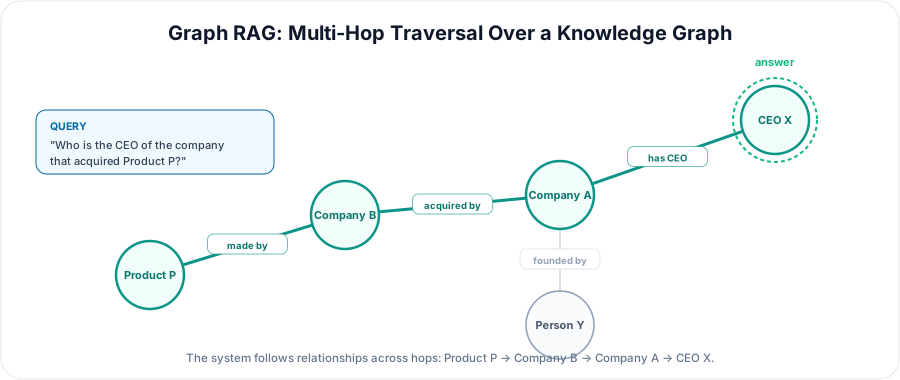
- Do multi-hop reasoning ("who is the CEO of the company that acquired X?").
- Answer global / summary questions ("what are the main themes across all documents?").
These need structure and relationships, not just similarity.
What is Graph RAG?
Graph RAG retrieves over a knowledge graph: nodes are entities or concepts, and edges are the relationships between them. Instead of fetching lone chunks, it traverses the graph to gather connected context — often alongside vector search.
How It Works
Indexing extracts entities and relations (usually with an LLM) to build the graph; retrieval finds relevant entities and traverses to connected context.
Local vs. Global Search
- Local search — entity-focused questions: traverse the neighbourhood of the relevant entities.
- Global search — whole-dataset / theme questions: use hierarchical community summaries built over the graph.
This local/global split was popularised by Microsoft GraphRAG.
Why It Works
Because relationships are explicit, the system can follow chains of reasoning ("the company that acquired X → its CEO"). Community summaries give a global view of the corpus. The result is more connected — and more explainable (you can trace the path) — than similarity alone.
Microsoft GraphRAG
The best-known implementation: an LLM builds an entity-relationship graph, clusters it into communities, and generates summaries at multiple levels — then answers with local (entity) or global (summary) search.
Trade-offs
- Expensive to build — LLM extraction over the whole corpus means many calls, cost, and time.
- Complex, with graph maintenance and updates to manage.
- Overkill for simple factoid Q&A.
When to Use It
- Interconnected knowledge and relational / multi-hop queries.
- Global / summary questions across a corpus.
- Research, investigations, and enterprise knowledge bases.
- Often used hybrid — graph plus vector search together.
Summary
- Graph RAG retrieves over a knowledge graph (entities + relationships), not just chunks.
- It enables multi-hop reasoning and global questions that vector RAG can't handle.
- Indexing extracts entities/relations; retrieval traverses the graph for connected context.
- Local search handles entities; global search uses community summaries.
- It's powerful but costly to build — best for complex, relational knowledge, often hybrid with vector search. EOF echo created