Faithfulness (RAG Evaluation)
Recall and precision judge retrieval; faithfulness judges generation. Faithfulness (also called groundedness) asks: is the LLM's answer actually supported by the retrieved context — or did it make things up? It's the metric most directly tied to RAG's core promise: grounded, trustworthy answers.
💡 In one line: Faithfulness measures whether every claim in the answer is supported by the retrieved context — i.e. no hallucination.
What is Faithfulness?
Faithfulness is the degree to which the answer's claims are grounded in the retrieved context. High faithfulness means no hallucination — every statement can be traced back to the sources.
Retrieval vs. Generation Metrics
- Recall / precision — did we retrieve the right context?
- Faithfulness — did the LLM use it truthfully?
You can have perfect retrieval and still get an unfaithful answer if the model ignores the context or fabricates details. That's why generation needs its own metric.
How It's Measured
- Break the answer into individual claims.
- Check each claim against the retrieved context.
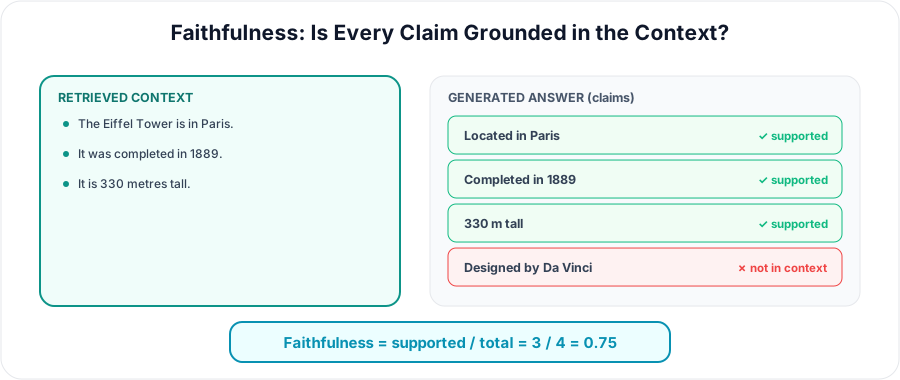
- Faithfulness = supported claims / total claims.
This is usually done with an LLM-as-judge (e.g. RAGAS's faithfulness metric).
The RAG Triad
Faithfulness is one of three metrics that together define a trustworthy RAG answer:
- Context relevance — is the retrieved context relevant to the query? (retrieval)
- Faithfulness — is the answer grounded in that context? (generation)
- Answer relevance — does the answer actually address the query? (generation)
Faithfulness vs. Answer Relevance
- Faithfulness — truthful to the sources.
- Answer relevance — actually answers the question.
A faithful answer can still be irrelevant (grounded but off-topic), and a relevant answer can be unfaithful (on-topic but invented). Measure both.
Why It Matters
RAG exists to give grounded, verifiable answers. An unfaithful answer is a hallucination — it defeats the entire purpose, erodes trust, and is dangerous in high-stakes domains like medicine, law, or finance.
Causes of Low Faithfulness
- The LLM leans on its parametric memory instead of the context.
- Poor retrieval — the needed context wasn't provided.
- Too much noise (low precision) crowds out the truth.
- A weak prompt that didn't say "answer only from the context."
Improving Faithfulness
- Prompt it: "Answer only from the provided context; if it's not there, say you don't know."
- Better retrieval (recall + precision) and reranking.
- Citations / attribution — forces grounding and enables verification.
- Clean, focused context; a stronger model; and guardrails.
Example
If an answer makes 4 claims and 3 are supported by the context (one fabricated):
Summary
- Faithfulness measures whether the answer is grounded in the retrieved context.
- It's a generation metric — distinct from retrieval's recall/precision.
- Measured as supported claims / total claims, often via LLM-as-judge (RAGAS).
- It's part of the RAG triad with context relevance and answer relevance.
- Improve it by prompting for grounding, better retrieval, reranking, and citations. EOF echo created