Introduction
Threads provide lightweight concurrent execution inside processes and are fundamental to modern operating systems and software systems. However, operating systems do not expose thread management directly through raw kernel interfaces for most application programming.
Instead, applications usually interact with threads through:
Thread libraries
Thread libraries provide APIs for:
Creating threads
Synchronizing execution
Managing shared resources
Coordinating concurrent tasks
One of the most important and widely used thread libraries is:
POSIX Threads (pthreads)
POSIX threads are extensively used in:
Linux systems
UNIX systems
Servers
Databases
Cloud infrastructure
High-performance computing
Concurrent applications
Understanding pthreads is essential because they provide practical implementation of:
Multithreading
Synchronization
Concurrency control
Parallel programming
What is a Thread Library?
A thread library is a collection of APIs and runtime support mechanisms that allow applications to create and manage threads.
Thread libraries provide:
Thread creation functions
Synchronization primitives
Scheduling interfaces
Communication mechanisms
Core Idea
Thread libraries provide programming interfaces for concurrent execution
Important Insight
Thread libraries abstract low-level thread management complexity for applications
What are POSIX Threads (pthreads)?
POSIX Threads, commonly called:
pthreads
are a standardized thread programming API defined by:
POSIX (Portable Operating System Interface)
POSIX threads provide:
Portable multithreading APIs across UNIX-like systems.
Widely supported on:
Linux
macOS
BSD
UNIX systems
Important Insight
pthreads provide standardized multithreading support across POSIX-compliant systems
Why pthreads are Important
pthreads enable:
Concurrent execution
Parallel processing
Efficient resource sharing
Thread synchronization
They are foundational for:
Systems programming
High-performance servers
Parallel applications
Visualization of pthread-Based Multithreading
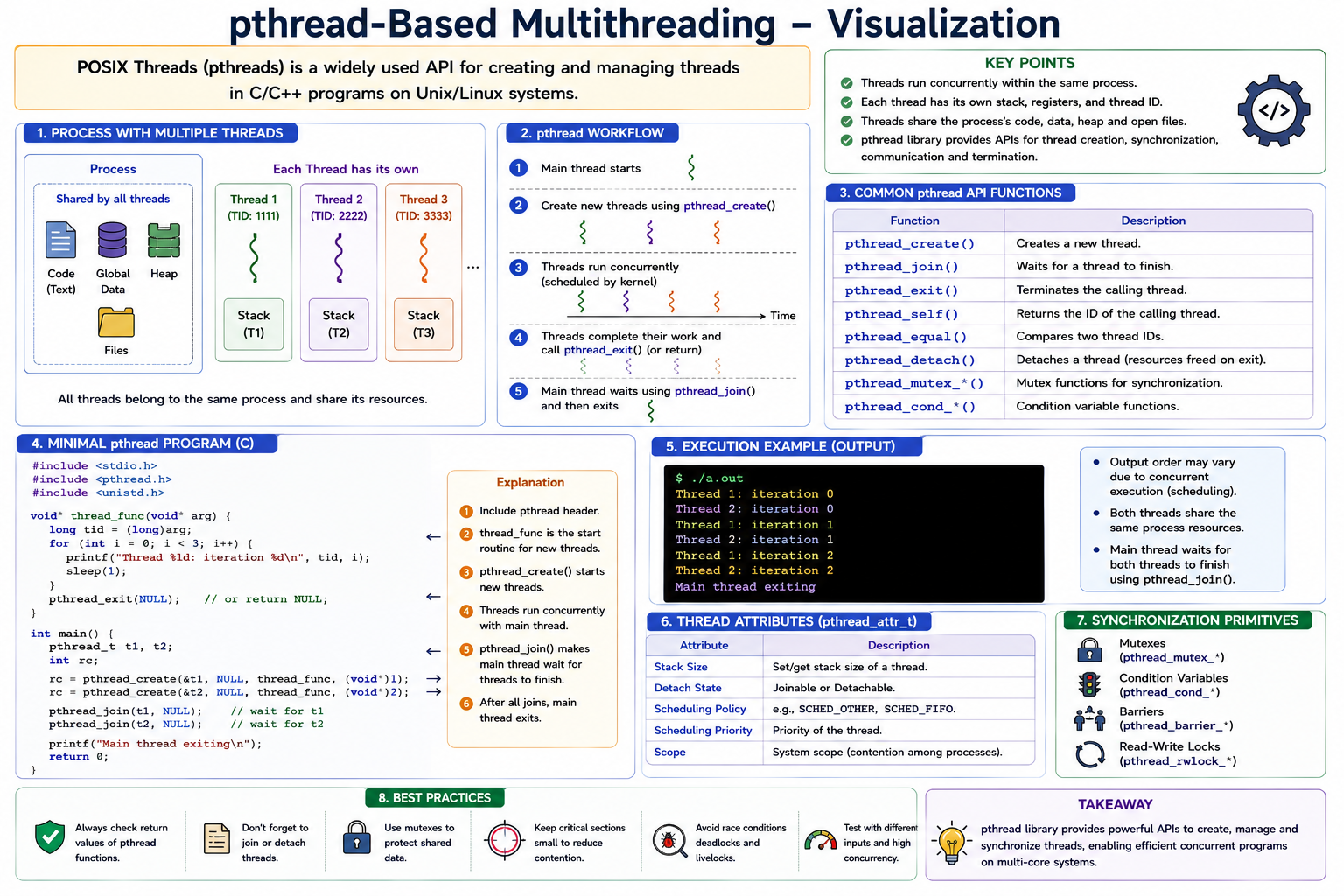
Including pthread Library
In C programs:
#include <pthread.h>
Compilation usually requires:
gcc file.c -pthread
Thread Creation in pthreads
Threads created using:
pthread_create()
Syntax
pthread_create(thread, attr, function, argument);
Example
pthread_t tid;
pthread_create(&tid, NULL, worker, NULL);
Parameters
thread
Stores thread ID.
attr
Thread attributes.
function
Function executed by thread.
argument
Argument passed to thread function.
Important Insight
pthread_create() starts concurrent execution of a new thread inside the same process
Thread Execution
Each thread executes:
Independently
Concurrently
within same process address space.
Example
Suppose process creates:
5 threads
All threads share:
Heap
Global variables
Files
but each thread has:
Separate stack
Registers
Thread Termination
Threads terminate:
Automatically after function completion
Explicitly using pthread_exit()
Example
pthread_exit(NULL);
Returning Values from Threads
Thread functions may return:
Results
Status information
using:
pthread_exit()
or return statements.
Thread Joining
Main thread may wait for another thread using:
pthread_join()
Syntax
pthread_join(thread, status);
Example
pthread_join(tid, NULL);
Purpose
Ensures:
Thread completion before continuing.
Important Insight
pthread_join() synchronizes thread completion between threads
Detached Threads
Threads may be:
Joinable
Detached
Joinable Thread
Another thread may wait for completion.
Detached Thread
Resources automatically released after termination.
Example:
pthread_detach(tid);
Thread IDs
Each thread has:
pthread_t
identifier.
Example
pthread_self()
returns current thread ID.
Shared Resources in pthreads
Threads share:
Global variables
Heap memory
Open files
Advantages:
Fast communication
Risks:
Race conditions
Race Conditions
Occurs when:
Multiple threads access shared data concurrently without synchronization.
Example
counter++;
Two threads may update incorrectly simultaneously.
Important Insight
Shared memory makes synchronization essential in multithreaded programs
Thread Synchronization
pthreads provide synchronization mechanisms.
Major synchronization tools:
Mutexes
Condition variables
Read-write locks
Barriers
Spinlocks
Mutexes in pthreads
Mutex:
Mutual exclusion lock
Ensures:
Only one thread accesses critical section at a time.
Mutex Workflow
Step 1
Thread locks mutex.
Step 2
Executes critical section.
Step 3
Unlocks mutex.
Example
pthread_mutex_lock(&lock);
/* critical section */
pthread_mutex_unlock(&lock);
Visualization of Mutex Synchronization
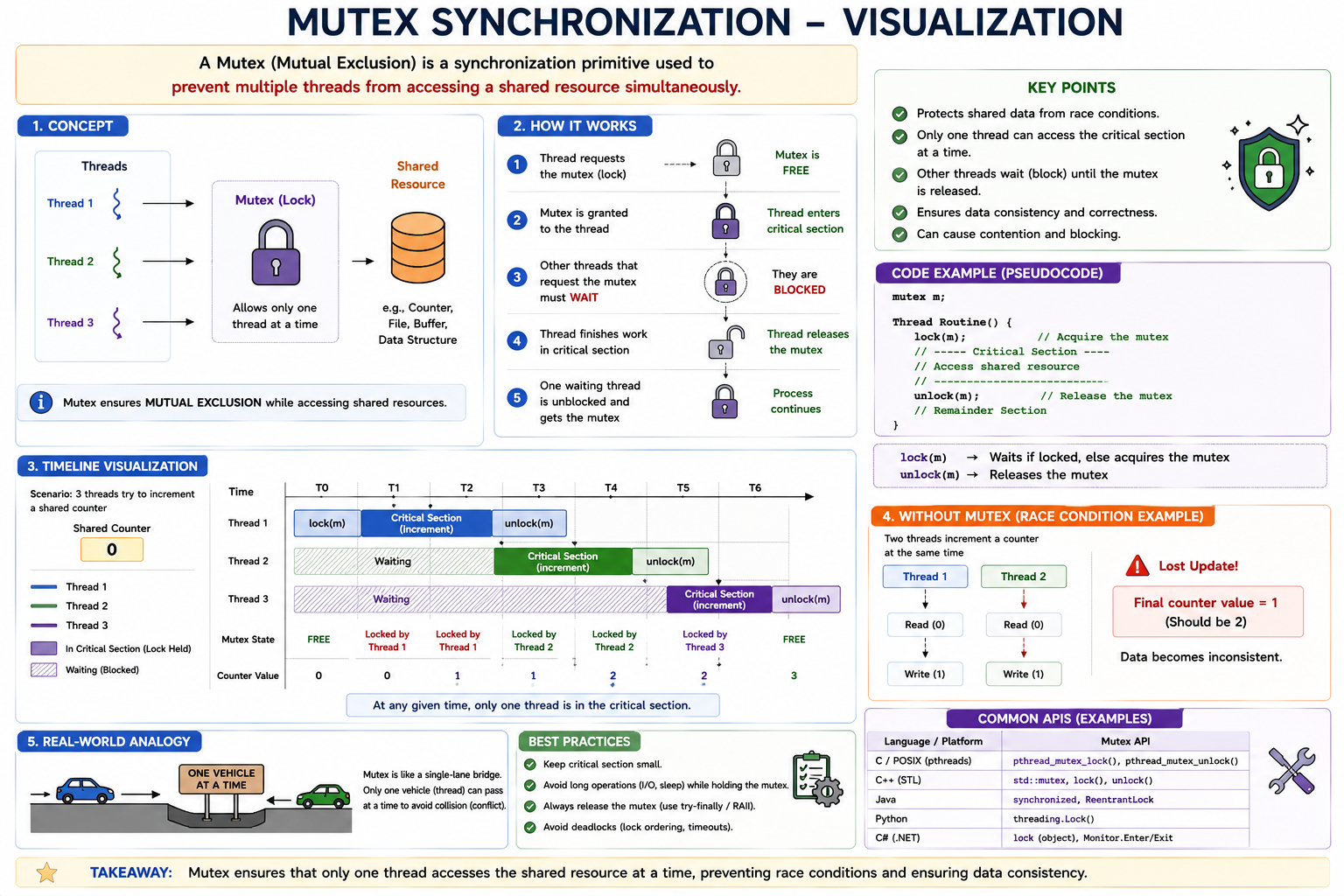
Mutex Initialization
Static Initialization
pthread_mutex_t lock = PTHREAD_MUTEX_INITIALIZER;
Dynamic Initialization
pthread_mutex_init(&lock, NULL);
Condition Variables
Condition variables allow:
Threads to wait for events/conditions
Functions
Wait
pthread_cond_wait()
Signal
pthread_cond_signal()
Broadcast
pthread_cond_broadcast()
Producer-Consumer Example
Producer:
Adds data
Consumer:
Waits until data available
Condition variables coordinate:
Synchronization efficiently
Read-Write Locks
Allow:
Multiple readers simultaneously
Single writer exclusively
Advantages:
Better scalability for read-heavy workloads
Barriers
Barrier synchronization forces:
Threads to wait until all reach synchronization point.
Example
Parallel computation stages.
Thread Scheduling
Kernel scheduler ultimately schedules pthreads in Linux.
Possible scheduling policies:
SCHED_OTHER
SCHED_FIFO
SCHED_RR
Thread Attributes
pthreads support:
Stack size
Scheduling policy
Priority
Detached state
through:
pthread_attr_t
Example
pthread_attr_init(&attr);
Thread Safety
Multithreaded programs must ensure:
Correct shared resource handling
Thread-safe code avoids:
Race conditions
Deadlocks
Data corruption
Deadlocks in pthreads
Occurs when threads wait indefinitely for locks.
Example
Thread A:
Holds Lock1
Waits for Lock2
Thread B:
Holds Lock2
Waits for Lock1
Important Insight
Improper synchronization can cause deadlocks in multithreaded programs
Performance Advantages of pthreads
1. Concurrency
Multiple tasks execute simultaneously.
2. Parallelism
Multicore utilization improved.
3. Responsiveness
Background tasks separated.
4. Lower Overhead
Threads cheaper than processes.
Challenges of pthread Programming
1. Synchronization Complexity
Shared memory dangerous.
2. Debugging Difficulty
Race conditions unpredictable.
3. Deadlocks
Incorrect locking harmful.
4. Scalability Challenges
Too many threads increase overhead.
Thread Pools and pthreads
Applications often use:
Thread pools
instead of creating threads repeatedly.
Advantages:
Reduced creation overhead
Better performance
Real-World Example
Suppose web server handles:
Thousands of requests
Using pthreads:
Worker threads created
Requests assigned concurrently
Mutexes protect shared data
Condition variables coordinate queues
Result:
High scalability
Better responsiveness
pthreads and Linux
Linux implements pthreads primarily using:
Kernel-level threads
Each pthread typically maps to:
Schedulable kernel entity