Introduction
The CPU is one of the most critical resources in any computing system because it executes instructions and performs computations for processes, applications, and operating system tasks.
Since CPUs are expensive and central to system performance, operating systems attempt to use them as efficiently as possible. A CPU sitting idle while tasks are waiting represents wasted computational capacity.
One of the most important performance metrics in operating systems and system optimization is:
CPU Utilization
CPU utilization measures how effectively the processor is being used during system execution.
Modern operating systems continuously monitor and optimize CPU utilization because it directly affects:
System performance
Throughput
Responsiveness
Energy efficiency
Scalability
Resource allocation
Understanding CPU utilization is essential for:
Operating systems
Performance engineering
Cloud computing
Distributed systems
Capacity planning
System administration
What is CPU Utilization?
CPU utilization is the percentage of time the CPU spends executing useful work rather than remaining idle.
Core Idea
CPU utilization measures how busy the processor is
Mathematical Representation
CPU\ Utilization = \frac{Busy\ Time}{Total\ Time} \times 100%
Example
Suppose:
CPU busy for 8 seconds
Total observation time = 10 seconds
Then:
CPU Utilization = 80%
Important Insight
Higher CPU utilization generally indicates better processor usage, but extremely high utilization may indicate overload
Why CPU Utilization Matters
Low CPU utilization may indicate:
Wasted hardware
Inefficient scheduling
I/O bottlenecks
Very high CPU utilization may indicate:
System overload
Poor responsiveness
Resource contention
Operating systems therefore try to maintain:
Efficient but balanced CPU usage
Visualization of CPU Utilization Concept
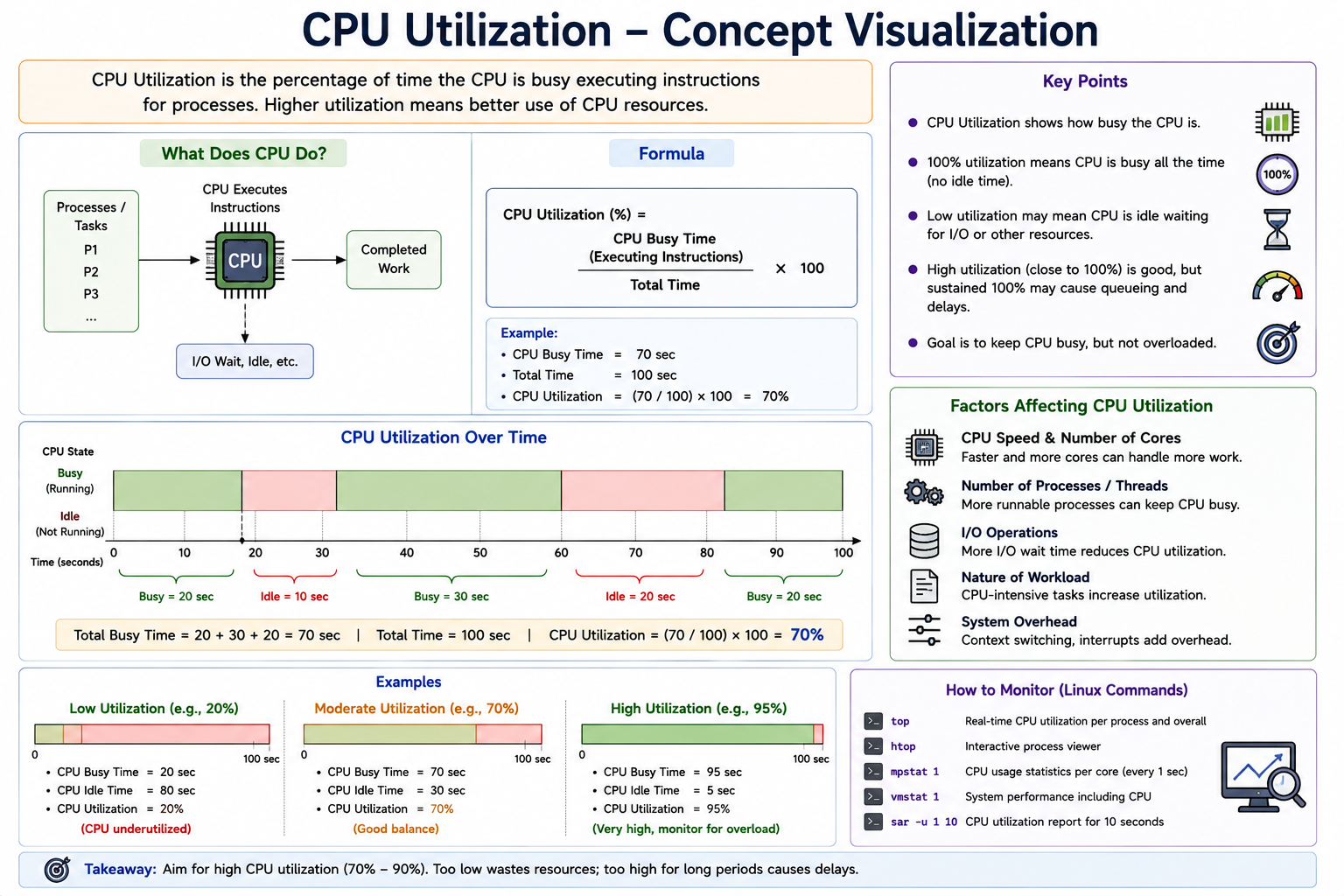
CPU Busy Time vs Idle Time
Busy Time
CPU actively executing:
User processes
Kernel operations
Interrupt handling
Idle Time
CPU waiting with no runnable tasks.
CPU Idle Process
Linux often uses:
Idle process
when no tasks available.
Important Insight
CPU utilization depends on the ratio of active execution time to idle time
CPU Utilization and Multiprogramming
Multiprogramming improves CPU utilization.
Problem Without Multiprogramming
Suppose one process waits for disk I/O:
CPU becomes idle
With Multiprogramming
OS switches to another ready process.
Advantages:
Better CPU utilization
Increased throughput
Example
Process A waits for disk.
Process B executes simultaneously.
CPU remains productive.
CPU Scheduling and Utilization
Scheduling directly affects utilization.
Good schedulers:
Keep CPU busy
Minimize idle time
Reduce unnecessary waiting
Example Scheduling Goals
Maximize CPU utilization
Maximize throughput
Minimize waiting time
Important Insight
Efficient scheduling is essential for maintaining high CPU utilization
CPU-Bound vs I/O-Bound Processes
Very important operating system concept.
CPU-Bound Process
Spends most time computing.
Examples:
Scientific calculations
Video rendering
Encryption
Characteristics:
High CPU utilization
I/O-Bound Process
Spends most time waiting for I/O.
Examples:
File servers
Databases
Network applications
Characteristics:
Lower CPU usage
Mixed Workloads
Operating systems often combine:
CPU-bound
I/O-bound processes
Advantages:
Better overall utilization
Example
While one process waits:
Another process computes
CPU Utilization in Multicore Systems
Modern processors contain:
Multiple cores
Utilization may be measured:
Per core
Overall system-wide
Example
Quad-core CPU:
One core fully busy
Others idle
Overall utilization:
25%
Load Average vs CPU Utilization
Students often confuse these concepts.
CPU Utilization
Measures:
Processor busy percentage
Load Average
Measures:
Number of runnable/waiting tasks
High load average may occur even if:
CPU not fully utilized
especially during:
I/O bottlenecks
CPU Utilization in Linux
Linux tracks:
User CPU time
System CPU time
Idle time
I/O wait time
Important Linux Tools
top
Dynamic CPU monitoring.
htop
Enhanced interactive monitoring.
vmstat
Virtual memory and CPU statistics.
mpstat
Per-core CPU statistics.
Example
top
CPU States in Linux Monitoring
User Time
CPU executing user applications.
System Time
CPU executing kernel code.
Idle Time
Unused CPU time.
I/O Wait
CPU waiting for I/O completion.
Steal Time
Virtualization-related waiting.
Important Insight
CPU utilization analysis requires understanding different processor activity states
Causes of Low CPU Utilization
1. I/O Bottlenecks
CPU waits for disks/networks.
2. Poor Scheduling
Inefficient task management.
3. Synchronization Delays
Processes blocked waiting for locks.
4. Underloaded Systems
Insufficient workload.
Causes of High CPU Utilization
1. CPU-Bound Workloads
Heavy computation.
2. Infinite Loops
Faulty software.
3. Excessive Context Switching
Scheduling overhead.
4. Resource Contention
Many tasks competing for CPU.
CPU Utilization and Throughput
Generally:
Better utilization improves throughput
However:
Extremely high utilization may reduce responsiveness.
Example
At:
100% CPU utilization
new tasks may experience:
Long delays
CPU Saturation
Occurs when:
CPU fully overloaded
Symptoms:
Increased latency
Queue buildup
Poor responsiveness
Important Insight
Maximum CPU utilization does not always mean optimal system performance
CPU Utilization and Context Switching
Context switching enables multitasking but introduces overhead.
Too many switches:
Waste CPU cycles
Example
Thousands of short tasks:
High switching overhead
Lower effective utilization
CPU Utilization in Cloud Computing
Cloud providers optimize:
CPU utilization across servers
Advantages:
Better cost efficiency
Reduced idle infrastructure
Virtualization and CPU Utilization
Hypervisors allocate CPU time among:
Virtual machines
Challenges:
Fair scheduling
Resource isolation
Overcommitment
CPU Affinity and Utilization
Binding tasks to specific CPUs may improve:
Cache locality
Performance efficiency
Energy Efficiency and CPU Utilization
Modern systems optimize:
Performance per watt
High utilization may:
Increase heat
Increase power consumption
Dynamic Frequency Scaling
CPUs adjust:
Clock speed dynamically
based on workload.
Examples:
Intel Turbo Boost
AMD Precision Boost
CPU Utilization in Real-Time Systems
Real-time systems carefully control utilization.
Reason:
Overloaded CPU may miss deadlines
Utilization Bound
Real-time scheduling theory defines:
Safe utilization limits
Bottlenecks and CPU Utilization
Sometimes CPU not bottleneck.
Other resources may limit performance:
Disk
Memory
Network
In such cases:
Increasing CPU power may not help.
Real-World Example
Suppose video streaming server handles many users.
During High Traffic
CPU utilization rises because:
More requests processed
If Utilization Becomes Too High
Users may experience:
Buffering
Increased latency
OS and load balancers may:
Distribute traffic
Launch additional servers
Advantages of High CPU Utilization
1. Better Resource Efficiency
Expensive hardware used effectively.
2. Improved Throughput
More work completed.
3. Better Cost Efficiency
Especially in cloud systems.
Risks of Excessively High CPU Utilization
1. Increased Latency
Longer waiting times.
2. Thermal Problems
Overheating risk.
3. Reduced Responsiveness
Interactive tasks delayed.
4. System Instability
Overloaded systems degrade.