Introduction
The Rectified Linear Unit (ReLU) is one of the most widely used activation functions in Deep Learning.
It introduced a simple yet highly effective way to add non-linearity to neural networks while avoiding some of the problems of Sigmoid and Tanh functions.
Today, ReLU is the default activation function for most deep neural networks.
What is ReLU?
The ReLU Activation Function returns:
- The input itself if the input is positive.
- Zero if the input is negative.
In simple terms:
ReLU keeps positive values and removes negative values.
Formula
f(x) = max(0, x) Output Range
0 ≤ f(x) < ∞Graph of ReLU
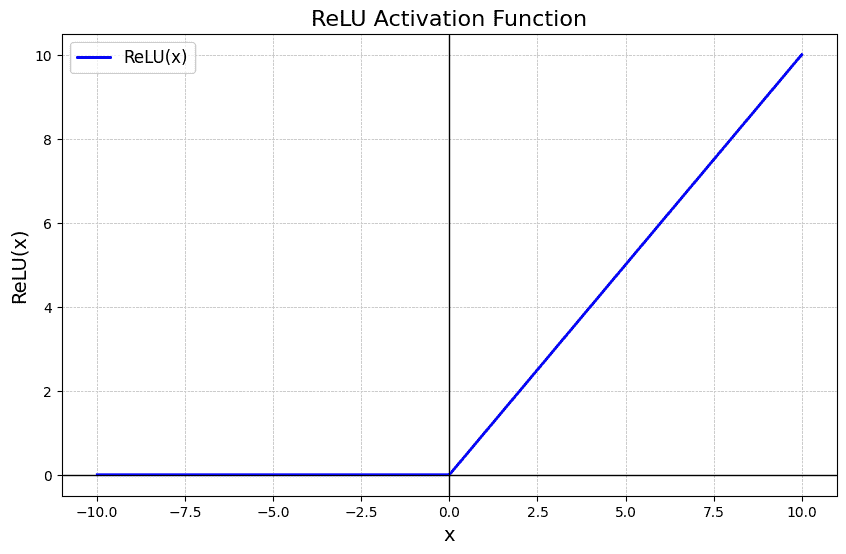
For negative values, the output is zero. For positive values, the output increases linearly.
How Does ReLU Work?
| Input (x) | Output f(x) |
|---|---|
| -5 | 0 |
| -2 | 0 |
| 0 | 0 |
| 3 | 3 |
| 8 | 8 |
Example
Input:
x = -4
Output:
ReLU(-4) = 0
Input:
x = 6
Output:
ReLU(6) = 6
Why is ReLU Important?
ReLU:
- Introduces non-linearity.
- Trains networks faster.
- Reduces the vanishing gradient problem.
- Makes deep networks practical.
Derivative of ReLU
f'(x) = 0, if x < 0f'(x) = 1, if x > 0Working of ReLU
Input↓
Apply ReLU
↓
Negative Values → 0
Positive Values → Same Value
Why is ReLU Better than Sigmoid and Tanh?
Sigmoid and Tanh compress outputs into a small range.
As networks become deeper:
- Gradients become very small.
- Training slows down.
ReLU solves this problem for positive inputs.
Advantages of ReLU
- Simple computation.
- Faster training.
- Less affected by vanishing gradients.
- Computationally efficient.
- Works well in deep networks.
Limitations of ReLU
- Outputs are not zero-centered.
- Can suffer from the Dying ReLU Problem.
- Negative inputs always become zero.
What is the Dying ReLU Problem?
Sometimes a neuron receives only negative inputs.
Since:
ReLU(x) = 0the neuron stops learning because its gradient becomes zero.
This is called the Dying ReLU Problem.
Applications of ReLU
| Application | Usage |
|---|---|
| CNNs | Hidden Layers |
| Image Classification | Feature Learning |
| Object Detection | Deep Networks |
| NLP Models | Hidden Layers |
| Transformers | Intermediate Layers |
Real-World Examples
- ChatGPT
- Image Classification
- Face Recognition
- Autonomous Vehicles
- Recommendation Systems
- Medical Image Analysis
ReLU vs Sigmoid
| Feature | ReLU | Sigmoid |
|---|---|---|
| Output Range | [0,∞) | (0,1) |
| Vanishing Gradient | Less | High |
| Training Speed | Fast | Slow |
| Deep Networks | Excellent | Poor |
ReLU vs Tanh
| Feature | ReLU | Tanh |
|---|---|---|
| Output Range | [0,∞) | (-1,1) |
| Vanishing Gradient | Less | High |
| Computational Cost | Low | Higher |
When Should You Use ReLU?
Use ReLU:
- In hidden layers.
- In CNNs.
- In deep neural networks.
- In computer vision applications.
Avoid using ReLU in output layers.
Best Practices
- Use ReLU as the default hidden-layer activation.
- Monitor for dying neurons.
- Consider Leaky ReLU or GELU if many neurons become inactive.
Interview Tip
A common interview question is:
"Why is ReLU widely used in Deep Learning?"
A strong answer is:
ReLU is computationally efficient and significantly reduces the vanishing gradient problem, allowing deep neural networks to train faster and achieve better performance.
Conclusion
The ReLU Activation Function revolutionized Deep Learning by making it possible to train very deep neural networks efficiently. Its simplicity, speed, and effectiveness have made it the most widely used activation function in modern AI systems.