Introduction
The Exponential Linear Unit (ELU) is an activation function designed to improve upon ReLU and Leaky ReLU.
It helps overcome problems such as:
- Dying ReLU
- Slow learning
- Non-zero-centered outputs
ELU has become a popular activation function in many deep learning applications.
What is ELU?
The Exponential Linear Unit (ELU) keeps positive inputs unchanged and applies an exponential function to negative inputs.
In simple terms:
ELU behaves like ReLU for positive values and smoothly curves for negative values.
Formula
f(x) = x, if x > 0f(x) = α(eˣ - 1), if x ≤ 0where:
- α is a constant (usually α = 1).
Output Range
(-α, ∞)For α = 1:
(-1, ∞)Graph of ELU
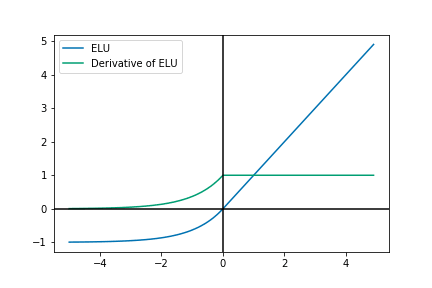
The negative side smoothly approaches −1 instead of becoming zero.
How Does ELU Work?
| Input (x) | Output f(x) |
|---|---|
| -3 | -0.95 |
| -1 | -0.63 |
| 0 | 0 |
| 2 | 2 |
| 5 | 5 |
(assuming α = 1)
Example
Input:
x = -1
Output:
ELU(-1) ≈ -0.63
Input:
x = 4
Output:
ELU(4) = 4
Why is ELU Important?
ELU:
- Reduces the Dying ReLU problem.
- Produces negative outputs.
- Makes activations closer to zero mean.
- Improves convergence speed.
Derivative of ELU
f'(x) = 1, if x > 0f'(x) = αeˣ, if x ≤ 0Working of ELU
Input↓
Apply ELU
↓
Positive Input → Same Value
Negative Input → Exponential Output
Advantages of ELU
- Solves Dying ReLU problem.
- Faster learning.
- Zero-centered activations.
- Smooth gradient for negative inputs.
- Better convergence than ReLU in some cases.
Limitations of ELU
- Computationally expensive because of exponentials.
- Slower than ReLU.
- Requires choosing α carefully.
Applications of ELU
| Application | Usage |
|---|---|
| CNNs | Hidden Layers |
| Image Classification | Feature Learning |
| Deep Neural Networks | Hidden Layers |
| Computer Vision | Object Detection |
| NLP Models | Feature Extraction |
Real-World Examples
- Image Recognition
- Medical Diagnosis
- Object Detection
- Face Recognition
- Recommendation Systems
ReLU vs ELU
| Feature | ReLU | ELU |
|---|---|---|
| Negative Output | 0 | Negative Values |
| Dying ReLU Problem | Yes | Reduced |
| Zero-Centered | No | Yes |
| Computational Cost | Low | Higher |
ELU vs Leaky ReLU
| Feature | ELU | Leaky ReLU |
|---|---|---|
| Negative Side | Exponential Curve | Linear |
| Zero-Centered | Better | Moderate |
| Computation | More Expensive | Faster |
When Should You Use ELU?
Use ELU:
- In deep neural networks.
- When ReLU neurons die frequently.
- When faster convergence is needed.
- When zero-centered activations are beneficial.
Best Practices
- Start with α = 1.
- Compare performance with ReLU and Leaky ReLU.
- Use ELU only in hidden layers.
- Monitor training speed.
Interview Tip
A common interview question is:
"Why is ELU sometimes preferred over ReLU?"
A strong answer is:
ELU allows negative outputs and avoids the Dying ReLU problem by using an exponential function for negative inputs, which often leads to faster and more stable learning.
Conclusion
The ELU Activation Function is an advanced activation function that improves upon ReLU by allowing negative outputs and smoother gradients. Although it is computationally more expensive, it can provide better convergence and performance in deep neural networks.