
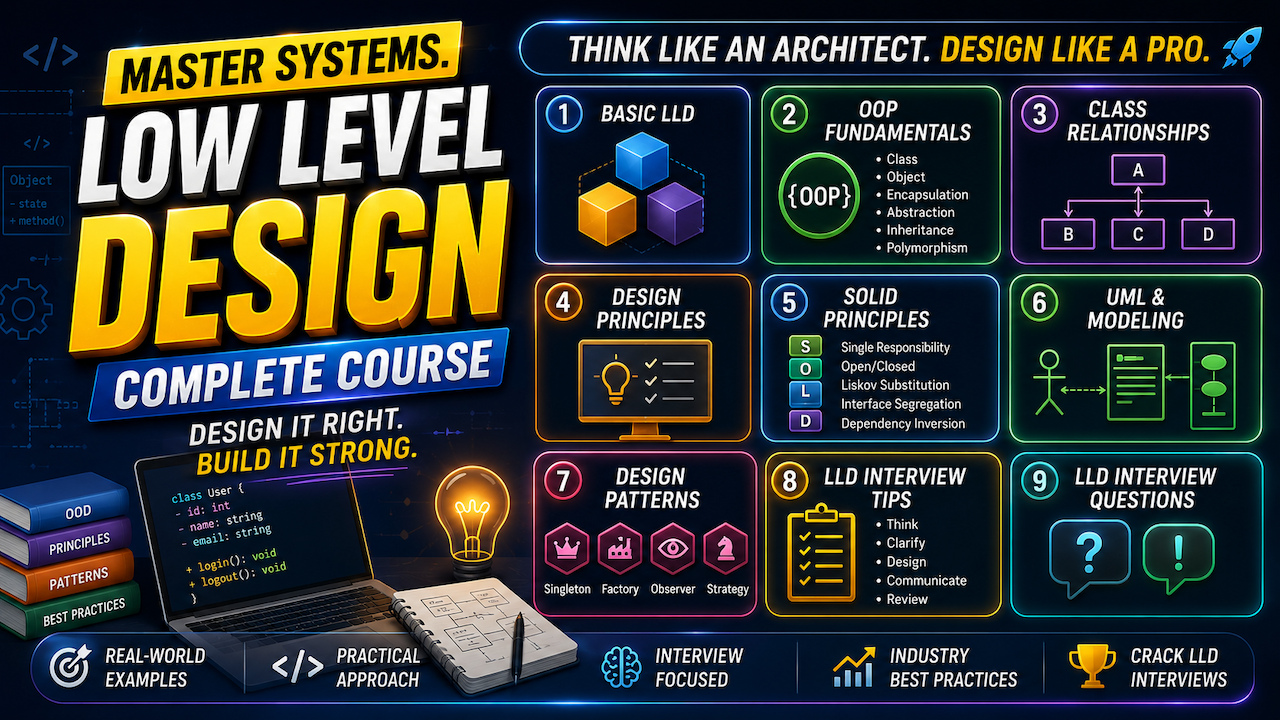
Low-Level Design (LLD)
Learn to Design Clean, Scalable and Maintainable Object-Oriented Software
Writing code that works is only the beginning. Professional software must also be easy to understand, extend, test, and maintain.
The Low-Level Design course teaches you how to convert software requirements into well-structured classes, objects, interfaces, relationships, and interactions. You will learn Object-Oriented Programming, SOLID principles, essential design principles, UML modeling, design patterns, and the systematic approach required to solve LLD interview problems.
Build practical systems such as Tic-Tac-Toe, Snake and Ladder, LRU Cache, Search Autocomplete, and a Simple Search Engine while learning how experienced developers make design decisions.
OOP Fundamentals • SOLID Principles • UML • Design Patterns • Practical LLD Problems
[Start Learning LLD] [Explore Curriculum]
Course at a Glance
| Course Detail | Information |
|---|---|
| 🎥 Video Lessons | 44 Structured Lessons |
| 📚 Course Sections | 8 Learning Sections |
| 🏗️ Practical Designs | 5 Complete LLD Problems |
| ⏱️ Course Duration | [Add Total Video Hours] |
| 📈 Difficulty Level | Beginner to Intermediate |
| 🗣️ Course Language | [Add Course Language] |
| 🏆 Certificate | Course-Completion Certificate |
| 📅 Access Validity | [Add Access Validity] |
| 🖥️ Learning Format | Self-Paced Recorded Course |
| 🎯 Best For | Developers, Students and Interview Candidates |
| 💰 Course Price | ₹[Add Final Price] |
Why Should You Learn Low-Level Design?
Many developers can solve coding problems but struggle when asked to design a complete application.
Questions such as these frequently appear in interviews:
- What classes should the system contain?
- What responsibility should each class have?
- How should the objects communicate?
- Should this relationship use inheritance or composition?
- Which design pattern is appropriate?
- How can the system support future requirements?
- How should the design be represented using UML?
- How can the design remain testable and maintainable?
LLD teaches you how to answer these questions systematically.
A strong understanding of Low-Level Design helps you:
- Convert requirements into software components
- Identify the correct classes, objects, and interfaces
- Assign clear responsibilities to classes
- Model relationships between objects
- Reduce tight coupling
- Improve cohesion and maintainability
- Apply SOLID and object-oriented principles
- Select appropriate design patterns
- Communicate designs through UML diagrams
- Write extensible and testable code
- Perform better in machine-coding and LLD interviews
What You Will Learn
By completing this course, you will be able to:
✅ Understand the purpose and scope of Low-Level Design
✅ Convert requirements into objects and responsibilities
✅ Apply Object-Oriented Programming concepts correctly
✅ Use abstraction, encapsulation, inheritance, and polymorphism
✅ Understand immutability and its design benefits
✅ Model association, aggregation, composition, and dependency
✅ Choose composition or inheritance appropriately
✅ Apply DRY, KISS, YAGNI, and the Law of Demeter
✅ Improve coupling and cohesion in software designs
✅ Apply all five SOLID principles
✅ Create important UML diagrams
✅ Understand essential creational design patterns
✅ Select patterns based on requirements—not by memorization
✅ Design complete object-oriented systems
✅ Explain design decisions clearly in interviews
✅ Write clean, extensible, testable, and maintainable code
Complete Course Curriculum
Section 1: Basic LLD
Begin with the purpose of Low-Level Design and understand where it fits in software development.
Topics Covered
- Introduction to Low-Level Design
- Why developers need LLD
- High-Level Design versus Low-Level Design
- Functional and non-functional requirements
- Moving from requirements to implementation
- Identifying entities and responsibilities
- LLD design process
- Qualities of a good object-oriented design
Section outcome: Understand what LLD is, why it matters, and how to begin designing a system.
Section 2: OOP Fundamentals
Build the object-oriented foundation required to create effective low-level designs.
Lessons
- Classes
- Objects
- Enums
- Interfaces
- Encapsulation
- Abstraction
- Inheritance
- Polymorphism
- Immutability
What You Will Understand
- How classes act as blueprints
- How objects represent real system entities
- How enums model fixed sets of values
- How interfaces define behavioural contracts
- How encapsulation protects internal state
- How abstraction hides unnecessary complexity
- How inheritance enables specialization
- How polymorphism supports flexible behaviour
- How immutability creates safer objects
Section outcome: Model requirements using well-defined objects, behaviours, and contracts.
Section 3: Class Relationships
Learn how classes and objects connect, communicate, and depend on one another.
Lessons
- Association
- Aggregation
- Composition
- Dependency
- Realization
What You Will Understand
- How independent objects communicate
- The difference between “has-a” relationships
- Weak and strong ownership
- Object lifecycle dependencies
- Temporary dependencies between classes
- How classes implement interfaces
- How relationships appear in UML
- How to select the correct relationship
Section outcome: Model object relationships accurately and avoid inappropriate coupling.
Section 4: Design Principles
Learn the foundational rules that make software simple, maintainable, and adaptable.
Lessons
- DRY Principle
- KISS Principle
- YAGNI Principle
- Law of Demeter
- Separation of Concerns
- Coupling and Cohesion
- Composition Over Inheritance
What You Will Understand
- How to remove unnecessary duplication
- Why simple solutions are easier to maintain
- How to avoid building features before they are required
- How to reduce unnecessary object dependencies
- How to separate different system responsibilities
- Why low coupling and high cohesion are desirable
- When composition is safer than inheritance
Section outcome: Make design decisions that reduce complexity and support future changes
Section 5: SOLID Principles
Master the five principles used to create flexible, testable, and maintainable object-oriented systems.
Lessons
- Single Responsibility Principle
- Open/Closed Principle
- Liskov Substitution Principle
- Interface Segregation Principle
- Dependency Inversion Principle
What You Will Understand
- How to give a class one clear reason to change
- How to extend behaviour without modifying stable code
- How to create safe and substitutable class hierarchies
- How to prevent large and unnecessary interfaces
- How abstractions reduce dependency on implementations
- How SOLID principles improve testing
- How to identify and refactor SOLID violations
Section outcome: Apply SOLID principles to create extensible and loosely coupled software.
Section 6: UML and Modeling
Learn how to visualize and communicate a software design before implementation.
Lessons
- Class Diagram
- Use Case Diagram
- Sequence Diagram
- Activity Diagram
- State Machine Diagram
What You Will Understand
- How to represent classes and relationships
- How to model system users and use cases
- How to show communication between objects
- How to represent workflows and decisions
- How to model object state transitions
- Which UML diagram to use in different situations
- How UML improves communication during interviews
Section outcome: Communicate system structure and behaviour using clear visual models.
Section 7: Design Patterns
Understand reusable solutions to recurring object-oriented design problems.
Lessons
- Introduction to Design Patterns
- Creational Patterns
- Singleton Pattern
- Factory Pattern
- Abstract Factory Pattern
- Builder Pattern
What You Will Understand
- What design patterns are
- Why patterns should solve problems rather than add complexity
- The main categories of design patterns
- How creational patterns control object creation
- When a single shared instance is appropriate
- How factories separate object creation from usage
- How Abstract Factory creates related object families
- How Builder constructs complex objects step by step
- Advantages and disadvantages of each pattern
- How to select an appropriate pattern
Section outcome: Apply essential creational patterns based on real design requirements.
Practical LLD Interview Problems
Apply the concepts from the course by designing realistic systems.
1. Design Tic-Tac-Toe
Learn how to model:
- Game board
- Players
- Symbols
- Moves
- Winning strategies
- Game state
- Extensible game rules
2. Design Snake and Ladder
Learn how to model:
- Board and cells
- Players
- Dice
- Snakes and ladders
- Player movement
- Winning conditions
- Game progression
3. Design LRU Cache
Learn how to combine:
- Cache entries
- Hash-based lookup
- Doubly linked structures
- Capacity management
- Least-recently-used eviction
- Constant-time operations
4. Design Search Autocomplete
Learn how to model:
- Search queries
- Prefix matching
- Suggestion ranking
- Search repositories
- Extensible ranking strategies
- Efficient suggestion retrieval
5. Design a Simple Search Engine
Learn how to model:
- Documents
- Indexing
- Queries
- Search services
- Matching logic
- Ranking strategies
- Extensible components
Practical outcome: Learn to transform an open-ended problem into requirements, entities, relationships, classes, interfaces, and working components.
Who Should Join This Course?
This course is ideal for:
- Students preparing for software-development roles
- Freshers preparing for LLD interviews
- Backend, frontend, and full-stack developers
- Developers who understand OOP but struggle with design
- Candidates preparing for machine-coding rounds
- Engineers who want to write maintainable software
- Developers moving toward senior engineering roles
- Anyone interested in object-oriented software design
Prerequisites
You should have:
- Basic programming knowledge
- Familiarity with variables, conditions, loops, and functions
- Basic understanding of classes and objects
- Ability to read object-oriented code
Previous system-design experience is not required.
Before and After This Course
| Before the Course | After the Course |
|---|---|
| Create classes without a clear plan | Identify classes from requirements |
| Place too many responsibilities in one class | Assign focused responsibilities |
| Confuse inheritance and composition | Select relationships intentionally |
| Know OOP definitions only | Apply OOP in real designs |
| Use patterns without understanding why | Select patterns based on problems |
| Create tightly coupled components | Design around abstractions |
| Struggle to draw UML diagrams | Communicate structure and behaviour visually |
| Feel lost in open-ended LLD questions | Follow a systematic design process |
| Write code that is difficult to extend | Create maintainable and extensible designs |
| Struggle to justify design choices | Explain decisions and trade-offs clearly |